Before Algorithms, There were Astrologers
How astrology moved from sacred science to social media meme — and why humanity keeps returning to the stars anyway.
There are a few widely circulated quotes on astrology is often attributed to J. P. Morgan:
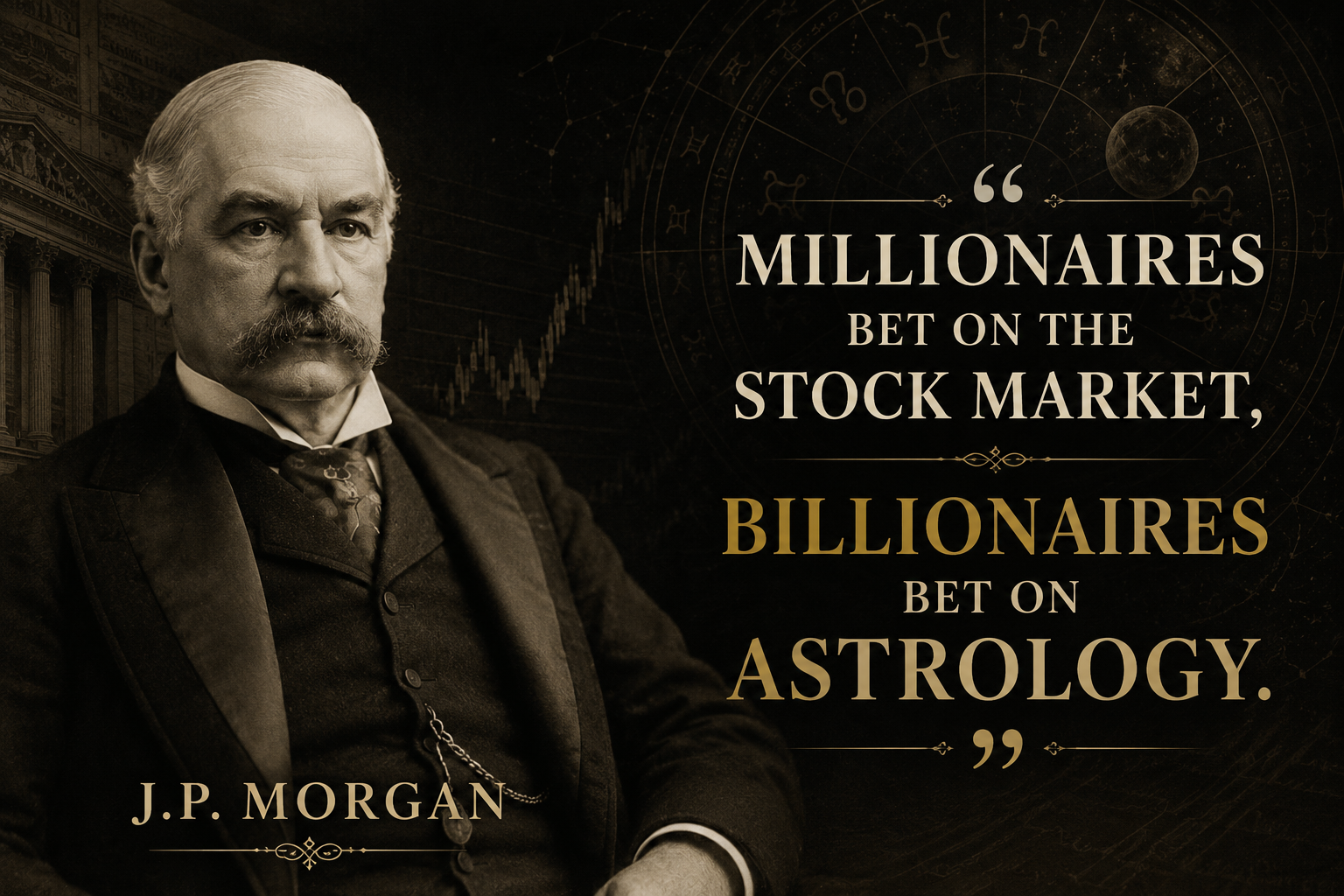
J.P. Morgan Quote
Or another: “Millionaires don’t use astrology, billionaires do.”
The quote itself is likely misattributed. There is no verified historical source proving Morgan actually said it. But thanks to the glorious fake-news-filled internet, the quote continues to circulate. There’s a reason though: it’s because it points toward a sacred truth that that timing, cycles, patterns, and human behavior matter.
And whether you call it it astrology, market psychology, seasonality, energetic cycles, or pattern recognition… humanity has always searched for systems that help make sense of things.
What is historically documented is that J.P. Morgan consulted astrologer Evangeline Adams during his lifetime. Astrologer Joan Quigley advised for the Reagan administration. But astrology’s roots stretch far deeper than modern politics or Wall Street. For most of human history, astrology was not considered fringe. It was interwoven with astronomy, mathematics, agriculture, medicine, and philosophy. Ancient civilizations tracked celestial cycles to understand seasons, tides, planting cycles, eclipses, collective events, and the rhythms of human life itself.
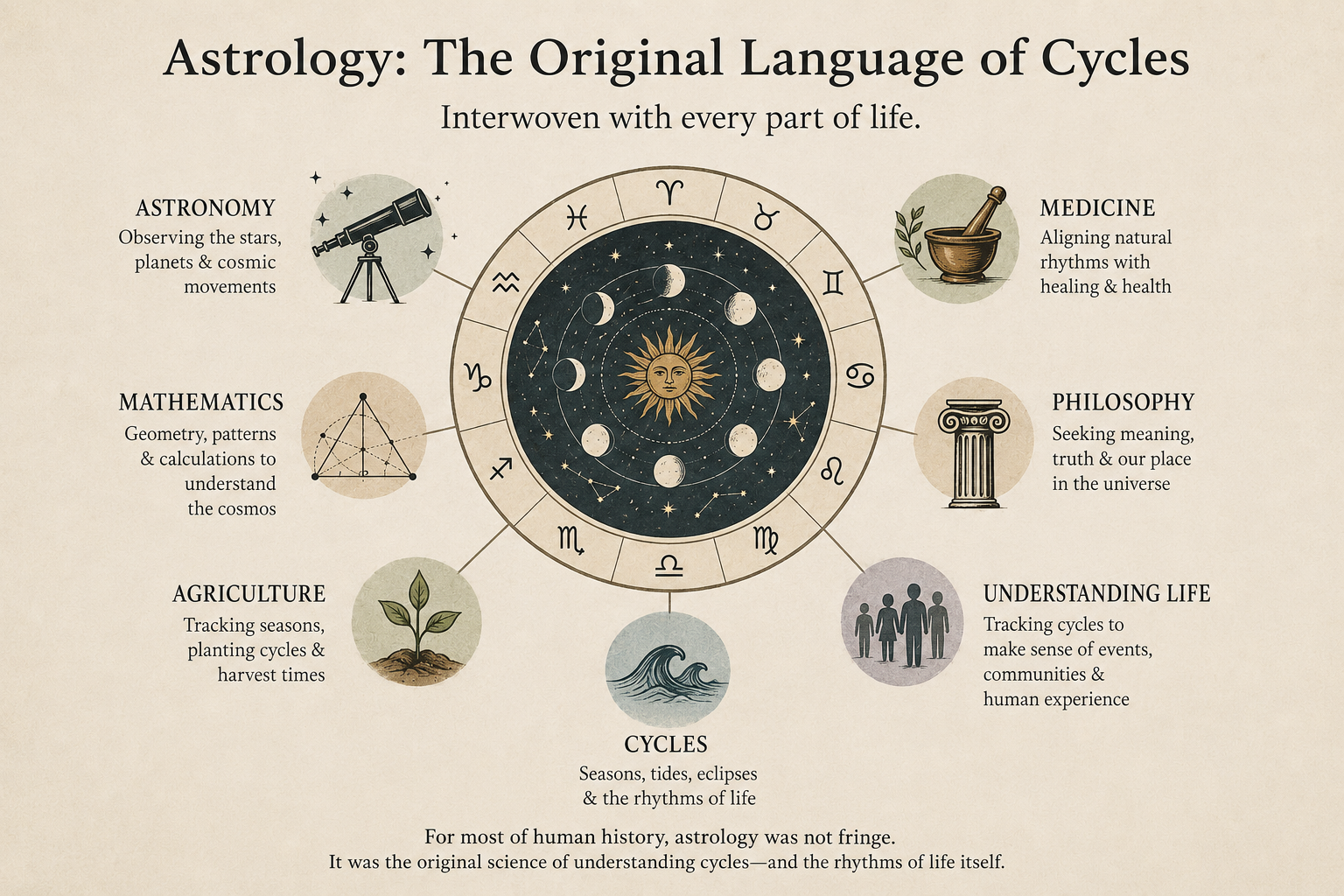
Historical Applications of Astrology
So where did astrology become labeled “pseudoscience”?
Part of the answer lies in the Scientific Revolution and the Age of Enlightenment. As science evolved toward empirical evidence measurement, repeatability, and material observation, disciplines that could not be consistently quantified in laboratory conditions began losing institutional legitimacy. Astronomy separated from astrology. One became measurable physics; the other remained symbolic interpretation.
And to be fair, astrology did become diluted over time.
Newspaper horoscopes reduced an extraordinarily complex symbolic system into twelve generalized personality blurbs. Pop culture turned astrology into entertainment. Social media compressed such a nuanced system and language into memes and one-line predictions. In many ways, astrology became both oversimplified and overclaimed simultaneously. That combination damaged credibility. At the same time, modern culture increasingly prioritized what could be externally measured over what could only be internally experienced.
Yet ironically, many respectable fields still operate heavily in probabilities, interpretation, patterns, and invisible influences:
psychology
economics
behavioral science
sociology
market forecasting
even weather prediction
None are perfectly predictive, but all involve pattern recognition. Astrology exists in a similar territory for many practitioners, but less as deterministic “fortune telling” and more as a symbolic language of cycles expressed in universal archetypes. The issue is that astrology was often presented as certainty when it may function better as a reflective framework. And perhaps where we “went wrong” culturally was assuming that if something cannot yet be fully measured materially, it therefore has no value psychologically, spiritually, symbolically, or observationally. Because humans themselves are not purely mechanical beings. We are emotional, intuitive, symbolic, patterned, relational, cyclical creatures.
Even the language of business reflects this reality:
market cycles
seasons of growth
momentum
expansion and contraction
timing
At its core, astrology is a symbolic timing system. A map of tendencies, themes, developmental cycles, and energetic climates. However: That does not mean astrology overrides free will. (that’s a whole other topic in and of itself—if you’re curious, let me know and I’ll write about it.)
And it certainly does not mean every meme astrologer on social media fully understands the depth of the system they’re using or every prediction is accurate. One of the biggest misconceptions people have about astrology today comes from oversimplification. Most people know only their Sun sign, which is comparable to trying to understand an entire business by looking only at its logo.
A real astrological analysis considers:
planetary placements
houses
aspects
transits
progressions
timing cycles
collective influences
generational placements
location-based calculations
exact birth time accuracy
Many online astrology apps and websites also use different house systems, approximated birth data, varying calculation methods, or generalized interpretations that may not fully reflect the complexity of the chart. Some tools are excellent starting points. Others are entertainment packaged as insight. Astrology becomes significantly more nuanced when viewed through a larger systems lens.
Because you are not only experiencing your astrology.
You are also experiencing astrology archetypes manifesting in the physical form of:
collective transits
generational themes
economic climates
technological eras
cultural conditioning
family systems
environmental influences
psychological development
This is why two people with the same Sun sign can live radically different lives.
In business, astrology can become less about “fortune telling” and more about awareness, timing, positioning, communication, and energetic alignment. Today, many entrepreneurs, creatives, and leaders use astrology to:
better understand leadership style
refine personal branding
identify natural strengths
improve communication
navigate burnout cycles
time launches and visibility periods
align offers with personal energy patterns
make sense of seasons of expansion or retreat
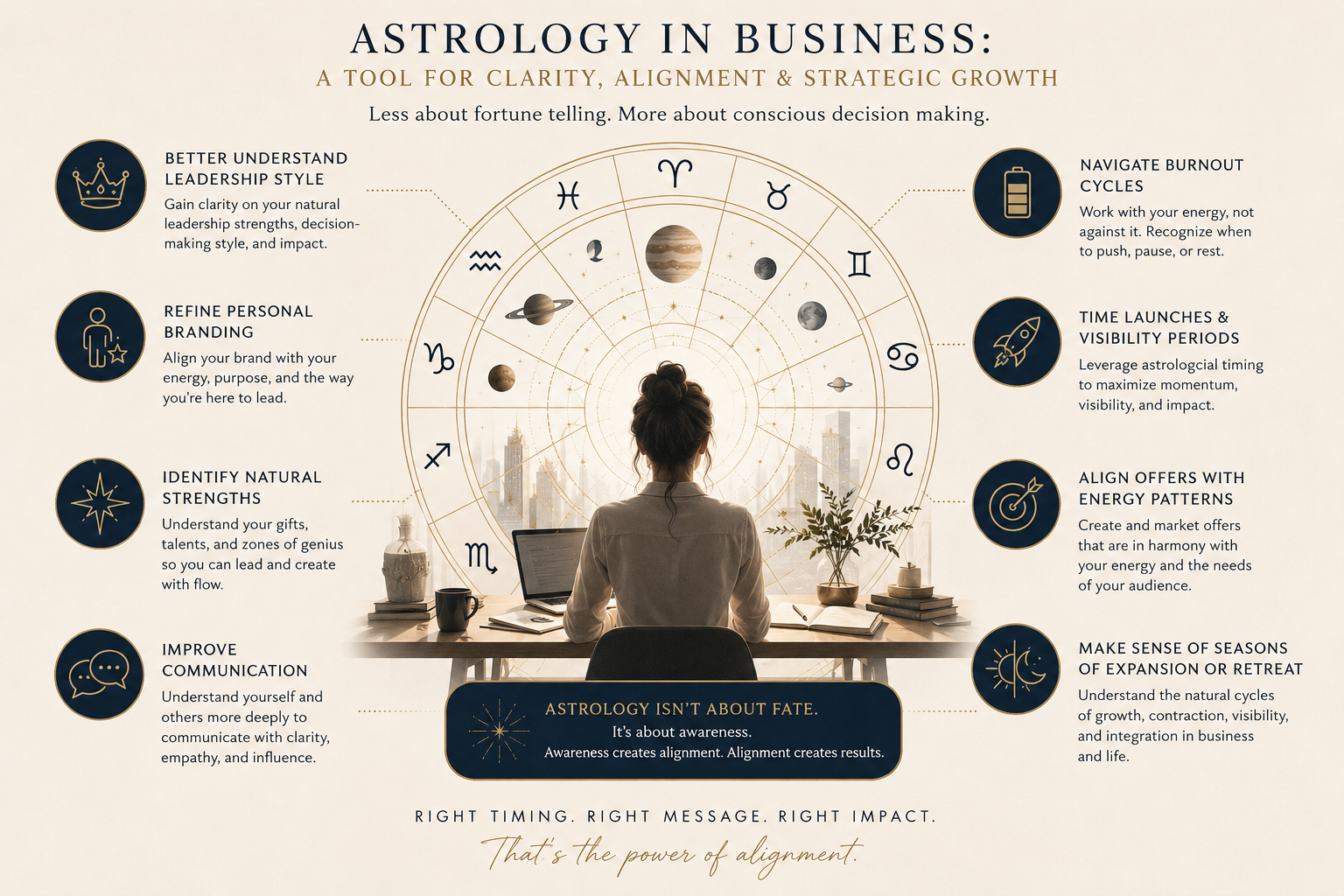
Astrology Applications in Business
A personal brand, after all, is an energetic signature expressed through communication, aesthetics, leadership, and values.
Astrology simply offers another symbolic language for understanding that signature more deeply. The future of conscious business will likely involve greater integration between psychology, behavioral science, emotional intelligence, systems thinking, spirituality, neuroscience, and symbolic frameworks like astrology. Because ultimately, business is human. And humans have always looked to the stars searching for meaning, guidance, timing, and perspective.
I’ve personally been studying astronomy and astrology for over 30 years, and over time I’ve come to see astrology as a sacred language — one that speaks through cycles, archetypes, timing, psychology, and pattern recognition. It’s a language I’ve become deeply fluent in from years of deep research and years of experiential learning through people, relationships, and the events that shape our lives and generations.
Whether you view astrology spiritually, psychologically, archetypally, or simply as a reflective tool for self-awareness, I believe its greatest value lies in helping us understand ourselves more deeply and move through life more consciously.
If you’re curious about my own chart and how I interpret astrology, you can explore that here: My Chart
And if astrology fascinates you, there’s a very good chance you’ll also love Human Design — a system that blends astrology, the I Ching, chakras, Kabbalah, and quantum mechanics into a fascinating framework for understanding personality, energy, decision-making, and purpose.
If you’d like to begin learning astrology beyond generalized horoscopes and social media snippets, download my “Learn Your Astrology” guide—it’s a grounded introduction to understanding your chart, the deeper mechanics of astrology, and how to start interpreting the basics of your natal chart.